


RONE
Powerhouse Geelong (detail) 2014
© RONE
RONE
Powerhouse Geelong (detail) 2014
© RONE

Rone
Without Darkness There is No Light (Light) (detail) 2021
(RONE in Geelong, Douglass Gallery installation, Geelong Gallery)
archival pigment print on Canson Baryta 310 gsm; A/P
Courtesy of the artist
Photographer: Rone
Rone
Without Darkness There is No Light (Light) (detail) 2021
(RONE in Geelong, Douglass Gallery installation, Geelong Gallery)
archival pigment print on Canson Baryta 310 gsm; A/P
Courtesy of the artist
Photographer: Rone

Rone
Without Darkness There is No Light (Dark) (detail) 2021
(RONE in Geelong, Douglass Gallery installation, Geelong Gallery)
archival pigment print on Canson Baryta 310 gsm; A/P
Courtesy of the artist
Photographer: Rone
Rone
Without Darkness There is No Light (Dark) (detail) 2021
(RONE in Geelong, Douglass Gallery installation, Geelong Gallery)
archival pigment print on Canson Baryta 310 gsm; A/P
Courtesy of the artist
Photographer: Rone

RONE in Geelong installation
(Geelong Gallery, 2021)
Photographer: Tony Mott
© Rone
RONE in Geelong installation
(Geelong Gallery, 2021)
Photographer: Tony Mott
© Rone

RONE in Geelong
installation view, Geelong Gallery 2021
Photographer: Andrew Curtis
RONE in Geelong
installation view, Geelong Gallery 2021
Photographer: Andrew Curtis

RONE in Geelong installation
(Geelong Gallery, 2021)
Photographer: Tony Mott
© Rone
RONE in Geelong installation
(Geelong Gallery, 2021)
Photographer: Tony Mott
© Rone

RONE in Geelong installation
(Geelong Gallery, 2021)
Photographer: Tony Mott
© Rone
RONE in Geelong installation
(Geelong Gallery, 2021)
Photographer: Tony Mott
© Rone

RONE in Geelong installation
(Geelong Gallery, 2021)
Photographer: Tony Mott
© Rone
RONE in Geelong installation
(Geelong Gallery, 2021)
Photographer: Tony Mott
© Rone

RONE
I’ve seen fire and I’ve seen rain 2016
(from the Empty series)
archival pigment print on Canson platine fibre rag
Geelong Gallery
Purchased with funds generously provided by Geelong Contemporary, 2019
RONE
I’ve seen fire and I’ve seen rain 2016
(from the Empty series)
archival pigment print on Canson platine fibre rag
Geelong Gallery
Purchased with funds generously provided by Geelong Contemporary, 2019

RONE
Geelong Cement Works 2017
© RONE
RONE
Geelong Cement Works 2017
© RONE
RONE in Geelong
Saturday 27 February to Sunday 16 May 2021
Over the last two decades, Geelong-born artist Rone has built an exceptional reputation for large-scale wall paintings and immersive installations that explore concepts of beauty and decay. Rone’s site-specific installation transformed a room within Geelong Gallery in response to the architecture and history of the building, and the Gallery’s collection.
The first comprehensive survey of Rone’s career to date was presented, charting the artist’s practice from early stencil works and street art, to photographs documenting major installations that have transformed abandoned spaces.
Set dressing by interior stylist Carly Spooner. Soundtrack composed by Nick Batterham.
A Geelong Gallery exhibition
*Concession tickets are valid for Full-time students aged over 15 years of age (includes high school, TAFE, university and international students, upon presentation of a valid student card), Pension card holders, Healthcare cardholders and Veterans Affairs cardholders (DVA gold cards). Seniors discount (concession price) available on Tuesday’s only.
**Child tickets are valid for children 5–15 years.
***Members tickets are valid for Geelong Gallery members, in addition to members of the following galleries: Art Gallery of Ballarat; Art Gallery of New South Wales; Art Gallery of South Australia; Art Gallery of Western Australia; Bendigo Art Gallery; Benalla Art Gallery; East Gippsland Art Gallery; Gippsland Art Gallery; Hamilton Gallery; Horsham Regional Art Gallery; Mornington Peninsula Regional Gallery; Murray Albury Museum of Art, Museum and Art Gallery of Northern Territory; Museum of Contemporary Art; National Gallery of Australia; National Gallery of Victoria; National Portrait Gallery; Queensland Art Gallery/Gallery of Modern Art; Shepparton Art Museum; Tasmanian Museum and Art Gallery; Wangaratta Art Gallery and Warrnambool Art Gallery.
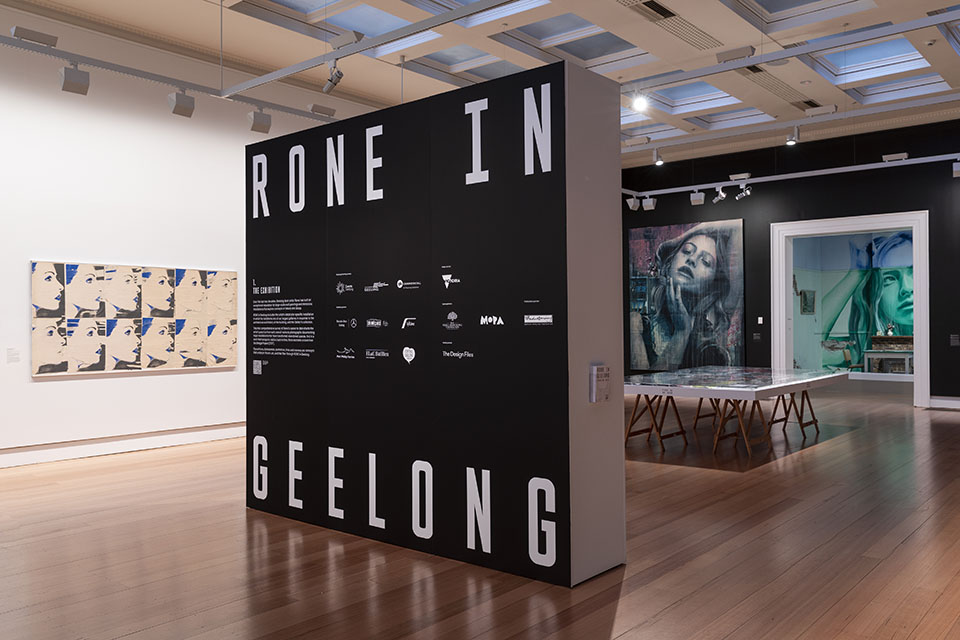

RONE in Geelong

Over the last two decades, Geelong-born artist Rone has built an exceptional reputation for large-scale wall paintings and immersive installations that explore concepts of beauty and decay.
RONE in Geelong includes the artist’s latest site-specific installation in which he transforms one of our largest galleries in response to the architecture and history of the building, and the Gallery’s collection.
This first comprehensive survey of Rone’s career to date charts the artist’s practice from early stencil works to photographs documenting major installations that have transformed abandoned spaces. And in a work that transports visitors back in time, Rone recreates a room from his Omega Project (2017).
Oppositions, dichotomies, portraiture, time and memory are concepts that underpin Rone’s art, and that flow through RONE in Geelong.
Over the last two decades, Geelong-born artist Rone has built an exceptional reputation for large-scale wall paintings and immersive installations that explore concepts of beauty and decay., RONE in Geelong includes the artist’s latest site-specific installation in which he transforms one of our largest galleries in response to the architecture and history of the building, and the Gallery’s collection.

Rone (Tyrone Wright)
born Geelong 1980; lives and works in Melbourne
The Tooth 2007
paper cut
On loan from Callum Preston
Rone (Tyrone Wright), The Tooth 2007

Rone (Tyrone Wright)
born Geelong 1980; lives and works in Melbourne
Jane Doe 2005
paper cut
Collection of the artist
Suzanne 2010
stencil on canvas
The Sandrew Collection
Rone (Tyrone Wright), Jane Doe 2005

The works in this room encompass two decades of Rone’s art practice. Early stencil works reflect his emergence in Melbourne’s street art scene. We see the evolution of Jane Doe and other female muses, and works layered with posters to simulate something of the raw and disparate aesthetics of street art.
The interplay between the street and the domestic interior is a predominating characteristic in Rone’s art, exemplified by his graphic interventions in abandoned houses and industrial spaces in projects including Empty and Alpha Project . More recently, the multi-roomed installations Omega Project and Empire are spaces in which Rone has crafted rich, mysterious narratives. Photo-documentation of these ephemeral site-specific installations has increasingly become an essential aspect of Rone’s practice, and is a strategy that links his recent work to his beginnings in street art.
As Rone has stated:
The concept of creating something beautiful within the context of decay and decline is central to the experience of any street artist. As is the idea that whatever you create might be gone the next day. For the artist, street art is all about embracing that transience and impermanence …
While the themes of transience and impermanence preoccupy Rone, the works in this survey are tangible evidence that even fleeting moments of creativity can endure. Collectively these works represent a narrative that is very different to, but equally as compelling as those Rone creates in his experiential but ephemeral installations.
The works in this room encompass two decades of Rone’s art practice. Early stencil works reflect his emergence in Melbourne’s street art scene. We see the evolution of Jane Doe and other female muses, and works layered with posters to simulate something of the raw and disparate aesthetics of street art., Empty The interplay between the street and the domestic interior is a predominating characteristic in Rone’s art, exemplified by his graphic interventions in abandoned houses and industrial spaces in projects including and Alpha Project . More recently, the multi-roomed installations Omega Project and Empire are spaces in which Rone has crafted rich, mysterious narratives. Photo-documentation of these ephemeral site-specific installations has increasingly become an essential aspect of Rone’s practice, and is a strategy that links his recent work to his beginnings in street art.

Rone (Tyrone Wright)
born Geelong 1980; lives and works in Melbourne
Julie (multi-posters) 2010
posters on wood panel Collection of the artist
Commissioned by Semi Permanent at Melbourne’s GPO, aMBUSH Gallery
Rone (Tyrone Wright), Julie (multi-posters) 2010

Rone (Tyrone Wright)
born Geelong 1980; lives and works in Melbourne
Pain and Guilt (i) 2011
stencilled spray enamel and acrylic polymer emulsion on screen-printed paper
The SANDREW Collection
Rone (Tyrone Wright), Pain and Guilt (i) 2011

RONE
The Green Room (Omega Project) 2017 archival pigment print on 310 gsm Canson Baryta; edition of 7
Courtesy of the artist
© RONE
RONEThe Green Room (Omega Project) 2017 archival pigment print on 310 gsm Canson Baryta; edition of 7Courtesy of the artist© RONE

Rone
Sub Rosa (detail) 2020
archival pigment print; A/P
Collection of the artist
Commissioned by Juddy Roller
© Rone
RoneSub Rosa(detail) 2020archival pigment print; A/PCollection of the artistCommissioned by Juddy Roller© Rone

RONE
The Study (Empire) 2019
archival pigment print on 310 gsm Canson Baryta
The Sandrew Collection
© RONE
RONEThe Study (Empire)2019archival pigment print on 310 gsm Canson BarytaThe Sandrew Collection© RONE

Rone (Tyrone Wright)
born Geelong 1980; lives and works in Melbourne
Without Darkness There is No Light (Alpha Project) 2017
archival pigment print on 310 gsm Canson Baryta; A/P
Collection of the artist
Rone (Tyrone Wright), Without Darkness There is No Light (Alpha Project) 2017

Rone (Tyrone Wright)
born Geelong 1980; lives and works in Melbourne
Forget The Past, You Can Only Change The Future 2014
acrylic polymer emulsion and mixed media on canvas
Collection of Sharyn Lowe
Rone (Tyrone Wright), Forget The Past, You Can Only Change The Future 2014

Rone_I’ve seen fire and I’ve seen rain_website
Rone_I've seen fire and I've seen rain_website
RONE
Geelong Cement Works 2017
© RONE
RONEGeelong Cement Works 2017© RONE

The Omega Project was a multi-room installation in which Rone transformed an abandoned Federation-era weatherboard cottage: the last remaining house on a redevelopment site neighbouring the decommissioned Alphington Paper Mill. Rone was invited to work in the cottage prior to its demolition. Working with interior stylist Carly Spooner, Rone created what he has described as a ‘fantasy film set’.
Throughout the seven dilapidated rooms an archetypal mid-century Australian home was reimagined. A recurring portrait of a young woman appeared on damaged walls, above rubble-strewn floors and beneath mildewed ceilings. Rone described the house as ‘Now on its last legs, marooned in a sea of progress awaiting its inevitable end, [it] serves as a potent symbol of defiance in the face of relentless change.’
For RONE in Geelong, the artist and his team recreated one of the Omega Project’s rooms—The Green Room. Rone’s work plays with time and its passing. He distorts time here conceptually through the re-materialisation of something that was demolished soon after it was created in 2017.
The Omega Project was a multi-room installation in which Rone transformed an abandoned Federation-era weatherboard cottage: the last remaining house on a redevelopment site neighbouring the decommissioned Alphington Paper Mill. Rone was invited to work in the cottage prior to its demolition. Working with interior stylist Carly Spooner, Rone created what he has described as a ‘fantasy film set’., Omega Project The was a multi-room installation in which Rone transformed an abandoned Federation-era weatherboard cottage: the last remaining house on a redevelopment site neighbouring the decommissioned Alphington Paper Mill. Rone was invited to work in the cottage prior to its demolition. Working with interior stylist Carly Spooner, Rone created what he has described as a ‘fantasy film set’.
Rone
Without Darkness There is No Light (Light) (detail) 2021
(RONE in Geelong, Douglass Gallery installation, Geelong Gallery)
archival pigment print on Canson Baryta 310 gsm; A/P
Courtesy of the artist
Photographer: Rone
RoneWithout Darkness There is No Light (Light) (detail) 2021(RONE in Geelong, Douglass Gallery installation, Geelong Gallery)archival pigment print on Canson Baryta 310 gsm; A/PCourtesy of the artistPhotographer: Rone

The Hitchcock Gallery displays works from the Gallery’s collection, including some of the originals that Rone has reproduced in his installation. They act as an aide-mémoire, linking the copy and the original, and juxtaposing a world of fantasy with reality.
The Gallery’s invitation to Rone to exhibit initiated his re-engagement with our collection and the institution that he visited in the formative years of his life. The general colour scheme of Rone’s installation takes its lead from early 20th century ceramics by Geelong-born artist Florence Royce. Their muted palette of greens, blues and pinks also inspired Rone’s selection of watercolours from the collection.
While the artist’s reputation for working in abandoned spaces and sites scheduled for imminent demolition may seem at odds with the ‘permanent’ edifice of the art museum and its purpose to preserve visual and material culture, Rone’s installation provokes new thinking on the very idea of the museum: of the images and objects that help shape individual and collective cultural memory; of the things we value as signs of our lives and times; and of what can so easily be lost.
The Hitchcock Gallery displays works from the Gallery’s collection, including some of the originals that Rone has reproduced in his installation. They act as an aide-mémoire, linking the copy and the original, and juxtaposing a world of fantasy with reality., aide-mémoire The Hitchcock Gallery displays works from the Gallery’s collection, including some of the originals that Rone has reproduced in his installation. They act as an , linking the copy and the original, and juxtaposing a world of fantasy with reality.
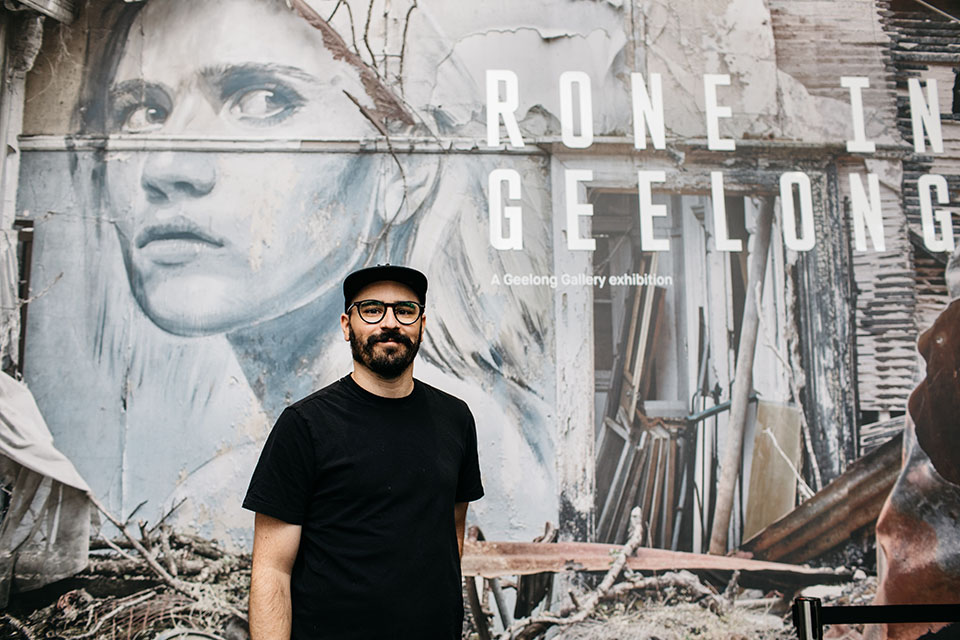
Tyrone Wright. RONE in Geelong Member’s preview, Geelong Gallery 2021. Photo Timothy Marriage-26 website
Tyrone Wright. RONE in Geelong Member's preview, Geelong Gallery 2021. Photo Timothy Marriage-26 website

The soundtrack to the exhibition is a suite of three pieces of classical music featuring musicians from the Melbourne Symphony Orchestra. In response to Rone’s concept of the abandoned function room with its two opposing ends being light and dark, the music features two separate ensembles that play off each other in a musical conversation of layered reflections and repetitions.
At the dark end of the room is the piano, augmented by wind and brass, while at the light end a string quartet plays. Melodies intertwine to form one larger ensemble before receding to their respective ends. The ensembles work both separately and together. At the light end of the room, the strings are mournful and sombre. Within the ensemble, each singular instrument is heard from a different seat at the dining table. The cello at one end, the violin at the other. The viola and bass fill the seats in between.
The suite of three pieces was written at the time of the devastating Black Summer bushfires of 2019–20 and reflects the sadness of these events. Prelude establishes the relationship between the solo piano at one end and the cello and viola at the other. Red Sun Sky is ominous and brooding: a ten-minute meditation on loss, conjuring the darkened skies, heavy with smoke and the deep crimson sun. As a very slow waltz, it alludes to a past when people danced in the now abandoned reception room. Dawn Chorus speaks of new beginnings, the resilience of nature and humanity. From the smallest signs of life, interwoven melodies grow to become a majestic fanfare. A sense of hope; a celebration of new life.
The soundtrack to the exhibition is a suite of three pieces of classical music featuring musicians from the Melbourne Symphony Orchestra. In response to Rone's concept of the abandoned function room with its two opposing ends being light and dark, the music features two separate ensembles that play off each other in a musical conversation of layered reflections and repetitions., Prelude The suite of three pieces was written at the time of the devastating Black Summer bushfires of 2019–20 and reflects the sadness of these events. establishes the relationship between the solo piano at one end and the cello and viola at the other. Red Sun Sky is ominous and brooding: a ten-minute meditation on loss, conjuring the darkened skies, heavy with smoke and the deep crimson sun. As a very slow waltz, it alludes to a past when people danced in the now abandoned reception room. Dawn Chorus speaks of new beginnings, the resilience of nature and humanity. From the smallest signs of life, interwoven melodies grow to become a majestic fanfare. A sense of hope; a celebration of new life.
RONE in Geelong kid's trail

In street art and graffiti tradition, artists sign their name using a ‘tag’. A tag name is a pseudonym, pen name or alias. These tags are created in various ways—using nicknames, initials, mixing up letters in their name or dropping letters, such as Tyrone becoming ‘Rone’.
Can you see the letters that spell out Rone’s name in these posters? Do you see parts of these posters anywhere else in Rone’s in the room?
Look closely at the portraits on the wall in RONE in Geelong.
In street art and graffiti tradition, artists sign their name using a ‘tag’. A tag name is a pseudonym, pen name or alias. These tags are created in various ways—using nicknames, initials, mixing up letters in their name or dropping letters, such as Tyrone becoming ‘Rone’., RONE in Geelong Look closely at the portraits on the wall in .

‘Jane Doe’ is a name used for a woman whose real name is unknown or is being intentionally concealed. In 2004, Rone’s Jane Doe figure began to appear throughout Melbourne on walls, bridges and façades and very quickly the image became instantly known as Rone’s work (you can see an image of Jane Doe in the previous room). Since this time, Rone has painted the face of different women in his work—what’s often known as an artist’s ‘muse’.
The unknown woman here is part of a reconstruction of Rone’s 2017 work, Omega Project, that he completed in an abandoned house next to the Alphington Paper Mill. You can create your own story about who this woman is, what her life in the house was like, and what she did?
‘Jane Doe’ is a name used for a woman whose real name is unknown or is being intentionally concealed. In 2004, Rone’s Jane Doe figure began to appear throughout Melbourne on walls, bridges and façades and very quickly the image became instantly known as Rone’s work (you can see an image of Jane Doe in the previous room). Since this time, Rone has painted the face of different women in his work—what’s often known as an artist’s ‘muse’., Omega Project The unknown woman here is part of a reconstruction of Rone’s 2017 work, , that he completed in an abandoned house next to the Alphington Paper Mill. You can create your own story about who this woman is, what her life in the house was like, and what she did?

The general colour scheme of Rone’s installation in the next room takes its lead from the ceramic works of early 20th century, Geelong-born artist, Florence Royce, and flows into his choice of watercolours from the collection.
Look for all the details in the room that are connected to Florence Royce’s ceramic patterns, or works that you think might be from the Geelong Gallery collection. Remember … Rone is working with reproductions or copies of the Gallery’s originals!
Like many families, Rone’s grandmother had a good china dinner and tea set, only used on special occasions! The consequences of breaking or misusing Gran’s good china were serious!
Colour inspiration

The installation in the next room is modelled on a grand reception room, a room in a large house, mansion, or hotel used for formal functions and parties and for entertaining visitors. Something seems to have gone wrong though: much of the room is decaying.
Rone’s installation is inspired by the tradition of trompe l’oeil painting, a technique that has been used by artists throughout history—trompe l’oeil is a French phrase that means to ‘deceive the eye’.
Look around the installation, what might have brought about this room’s decay?
The installation in the next room is modelled on a grand reception room, a room in a large house, mansion, or hotel used for formal functions and parties and for entertaining visitors. Something seems to have gone wrong though: much of the room is decaying., trompe l’oeil Rone’s installation is inspired by the tradition of painting, a technique that has been used by artists throughout history—trompe l’oeil is a French phrase that means to ‘deceive the eye’.

Frederick McCubbin
A bush burial 1890
oil on canvas
Geelong Gallery
Purchased by public subscription, 1900
Frederick McCubbinA bush burial1890oil on canvasGeelong GalleryPurchased by public subscription, 1900

Rone’s work focuses on opposing positions, for example light and dark, beauty and decay. In ancient Chinese philosophy, the symbol of Yin Yang represents a concept of both dark and light, positive and negative, opposites or contrary forces.
Look at the Yin Yang symbol, and you will see that within the black there is a small section of white, and within the white there is a small section of black. It is circular in shape, and revolves over and over, much like Rone’s work, which is built up and then torn down, never permanent.
All that remains are our memories and the photos taken by Rone.
Light & dark
